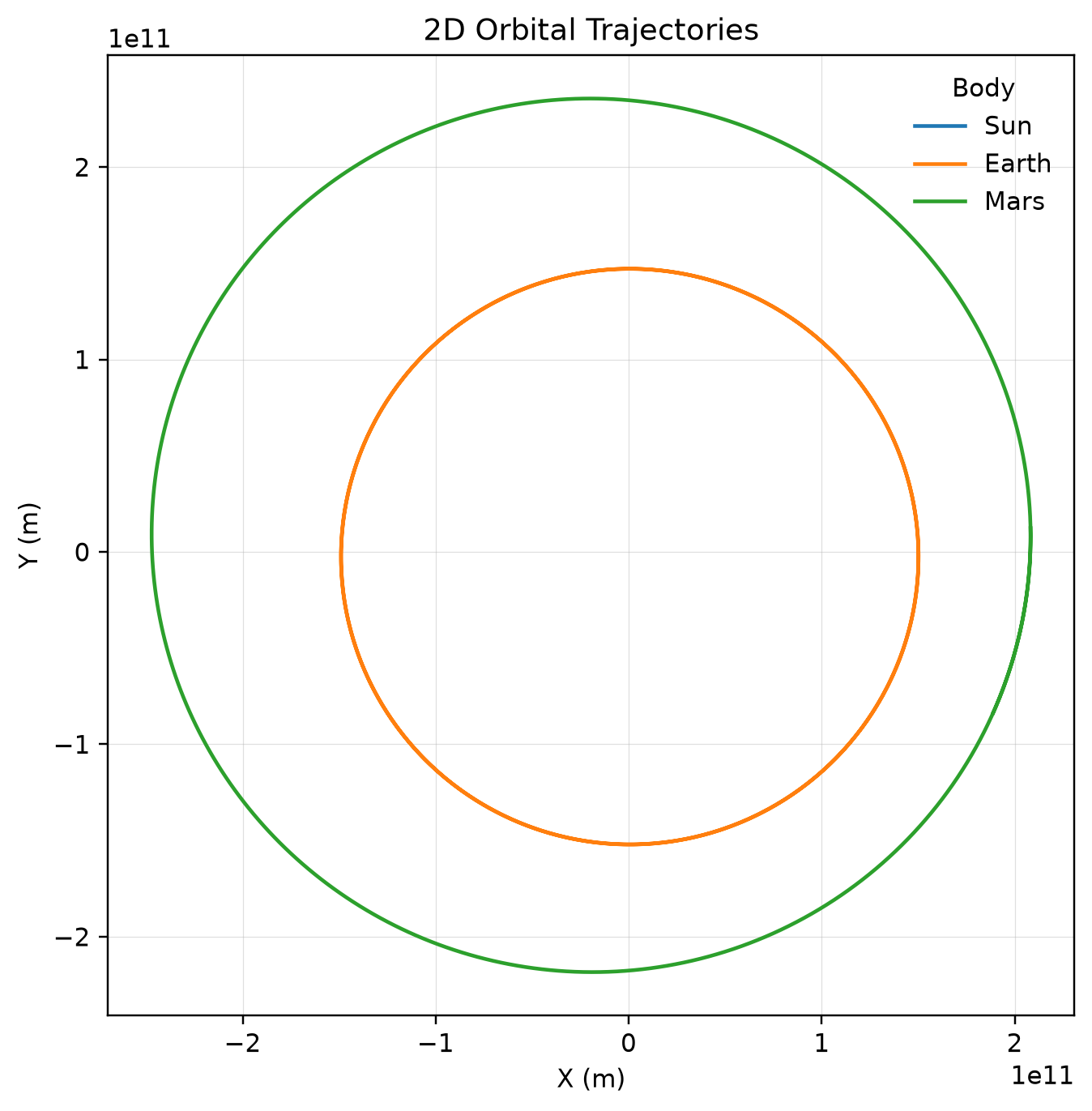
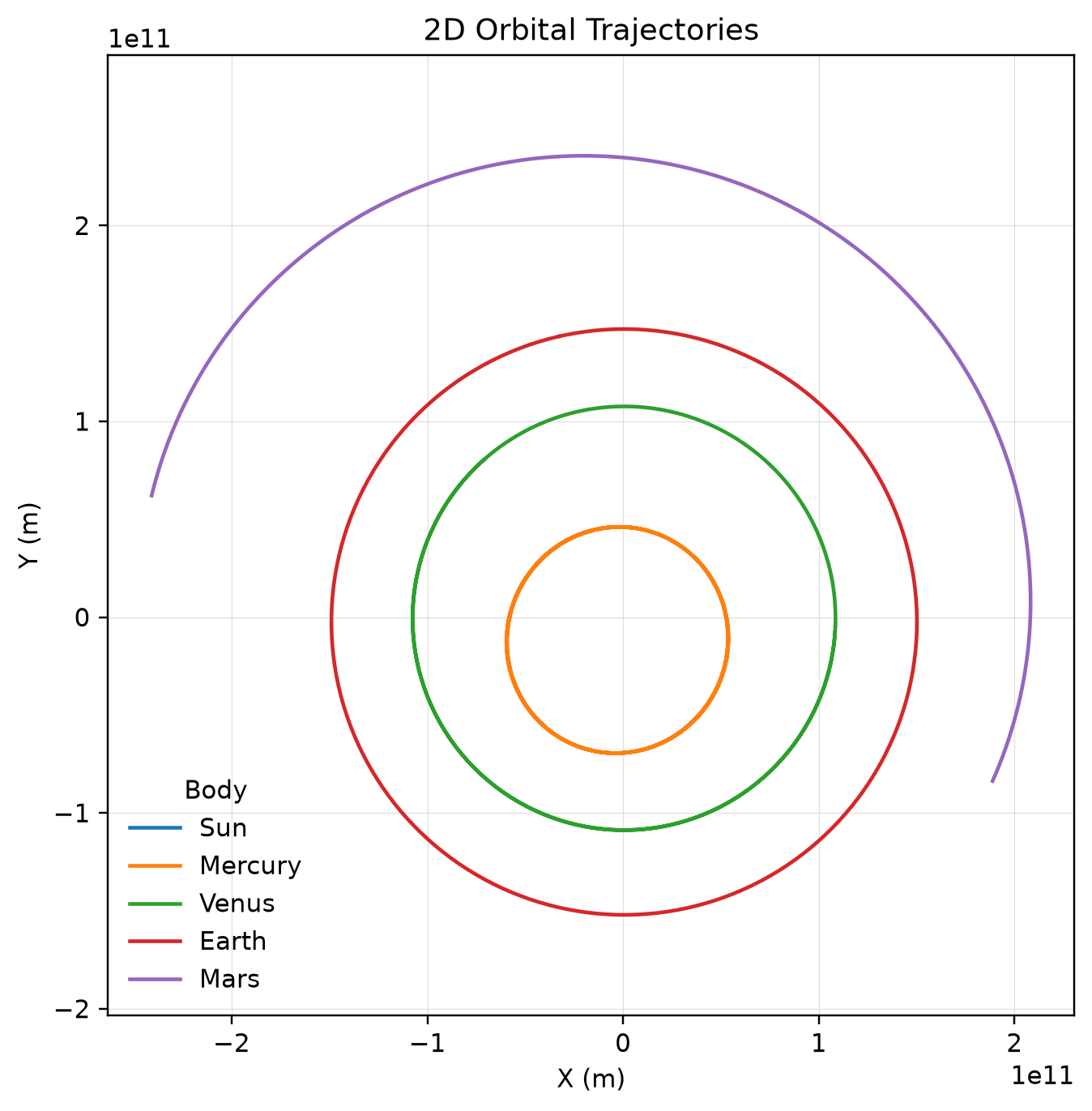
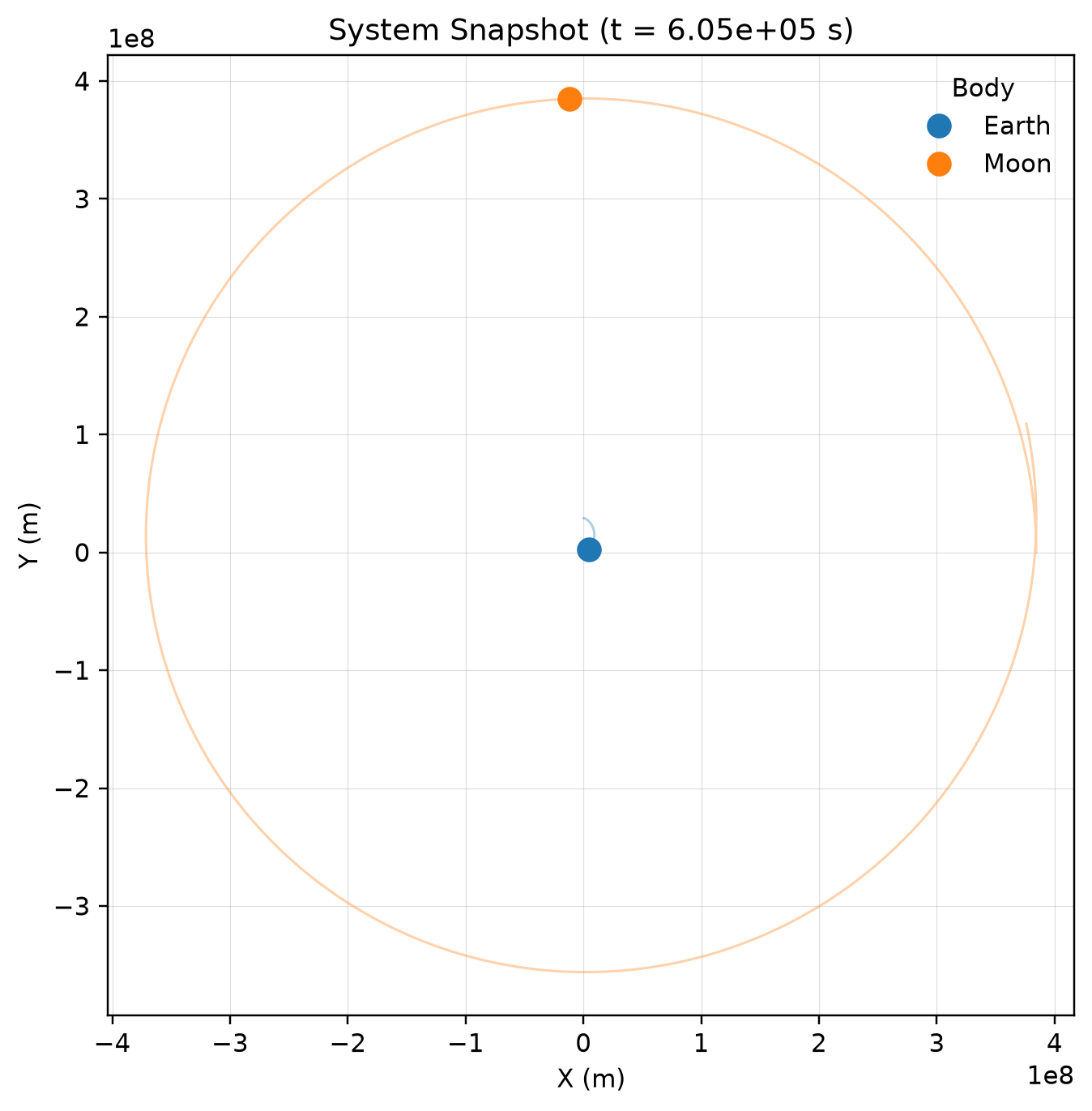
A tidy N-body physics engine for building and visualizing orbital simulations in Python.
pyorbiter is a lightweight N-body gravitational simulator. Build a system of bodies, integrate it forward in time, and get back a tidy DataFrame with one row per body per time step. Simulate planetary orbits, binary stars, or chaotic three-body problems in a few lines of chained method calls.
Units are SI throughout: meters, kilograms, seconds. Angles are in degrees.
Installation
pyorbiter is not on PyPI yet. Install it from GitHub:
It needs Python 3.10 or later, and installs numpy, pandas, and matplotlib. Three optional extras add interactive 3D plots (plotly), polars DataFrames, and GIF export (pillow):
Tidy output.simulate() returns a DataFrame with one row per body per time step and columns id, mass, x, y, z, vx, vy, vz, time. See the Quick Start.
pandas or polars. Results are pandas DataFrames by default. Call orb.set_backend("polars"), or pass backend="polars" to a single call, to get polars DataFrames instead. Every function accepts either kind. See pandas or polars.
Built-in physical constants. Masses, distances, and orbital speeds for the Sun, the eight planets, the Moon, and Pluto. See Physical Constants.
Cartesian or Keplerian input. Place a body by position and velocity with add_body(), or by orbital elements with add_body_keplerian(). See Building Two-Body Orbits and Keplerian Elements.
Three integrators. Velocity Verlet (the default), Euler-Cromer, and explicit Euler for comparison. See The Physics.
Conservation checks.conserved_quantities() reports energy, momentum, and angular momentum at every step, with their relative errors. See Conservation.
Reference frames.shift_reference_frame(sim, "Earth") re-centers a simulation on any body or on the barycenter. See Reference Frames.
2D and 3D plotting.plot_orbits() draws a matplotlib plot for planar motion and an interactive plotly figure when any body moves in z. See 3D Plotting and Custom Visualization.
Animations.animate_system() plays a simulation forward and can save it as a GIF.
Learn more
Quick Start: install, simulate, and plot your first orbit.
Examples: worked systems, from Earth and Moon to binary stars.
pyorbiter is the Python sibling of the R package orbitr. The two share function names, argument names, constants, and defaults, and the pyorbiter test suite checks its results against numbers produced by orbitr. If you work in both languages, what you learn in one carries over to the other.