import pyorbiter as orb

orb.mass_earth, orb.distance_earth_sun, orb.speed_earth
(5.972e+24, 149600000000.0, 29780)pyorbiter ships a set of real-world masses, distances, and orbital speeds so you do not have to look them up every time. All values are in SI units: kilograms, meters, and meters per second.
Every constant is a plain Python number at the top level of the package:
import pyorbiter as orb
orb.mass_earth, orb.distance_earth_sun, orb.speed_earth(5.972e+24, 149600000000.0, 29780)The tables on this page are built from the package itself when the site is rendered, so they always show the values you get when you import it. The names come from orb.constants.__all__, and this small helper turns the ones that share a prefix into a table:
import pandas as pd

def constants_table(prefix, unit, fmt):
    names = [name for name in orb.constants.__all__ if name.startswith(prefix)]
    names.sort(key=lambda name: getattr(orb, name))
    return pd.DataFrame({
        "value": [format(getattr(orb, name), fmt) for name in names],
        "unit": unit,
}, index=pd.Index(names, name="constant"))constants_table("gravitational", "m^3 kg^-1 s^-2", ".4e")| value | unit | |
|---|---|---|
| constant | ||
| gravitational_constant | 6.6743e-11 | m^3 kg^-1 s^-2 |
This is the default G of create_system().
constants_table("seconds", "s", ",.0f")| value | unit | |
|---|---|---|
| constant | ||
| seconds_per_hour | 3,600 | s |
| seconds_per_day | 86,400 | s |
| seconds_per_year | 31,557,600 | s |
A year here is a Julian year of 365.25 days. These are the natural way to write time_step and duration, for example duration=28 * orb.seconds_per_day.
constants_table("mass", "kg", ".3e")| value | unit | |
|---|---|---|
| constant | ||
| mass_pluto | 1.309e+22 | kg |
| mass_moon | 7.342e+22 | kg |
| mass_mercury | 3.301e+23 | kg |
| mass_mars | 6.417e+23 | kg |
| mass_venus | 4.867e+24 | kg |
| mass_earth | 5.972e+24 | kg |
| mass_uranus | 8.681e+25 | kg |
| mass_neptune | 1.024e+26 | kg |
| mass_saturn | 5.683e+26 | kg |
| mass_jupiter | 1.898e+27 | kg |
| mass_sun | 1.989e+30 | kg |
constants_table("distance", "m", ".3e")| value | unit | |
|---|---|---|
| constant | ||
| distance_earth_moon | 3.844e+08 | m |
| distance_mercury_sun | 5.791e+10 | m |
| distance_venus_sun | 1.082e+11 | m |
| distance_earth_sun | 1.496e+11 | m |
| distance_mars_sun | 2.279e+11 | m |
| distance_jupiter_sun | 7.785e+11 | m |
| distance_saturn_sun | 1.434e+12 | m |
| distance_uranus_sun | 2.871e+12 | m |
| distance_neptune_sun | 4.495e+12 | m |
| distance_pluto_sun | 5.906e+12 | m |
distance_earth_moon is the Moon’s distance from Earth. The others are distances from the Sun.
constants_table("speed", "m/s", ",.0f")| value | unit | |
|---|---|---|
| constant | ||
| speed_moon | 1,022 | m/s |
| speed_pluto | 4,740 | m/s |
| speed_neptune | 5,430 | m/s |
| speed_uranus | 6,800 | m/s |
| speed_saturn | 9,680 | m/s |
| speed_jupiter | 13,060 | m/s |
| speed_mars | 24,070 | m/s |
| speed_earth | 29,780 | m/s |
| speed_venus | 35,020 | m/s |
| speed_mercury | 47,360 | m/s |
speed_moon is the Moon’s speed around Earth. The others are speeds around the Sun.
With the constants, the Earth-Moon example can be written without a single number looked up by hand:
sim = (
    orb.create_system()
    .add_body("Earth", mass=orb.mass_earth)
    .add_body("Moon", mass=orb.mass_moon, x=orb.distance_earth_moon, vy=orb.speed_moon)
    .simulate(time_step=orb.seconds_per_hour, duration=orb.seconds_per_day * 28)
)

orb.plot_orbits(sim);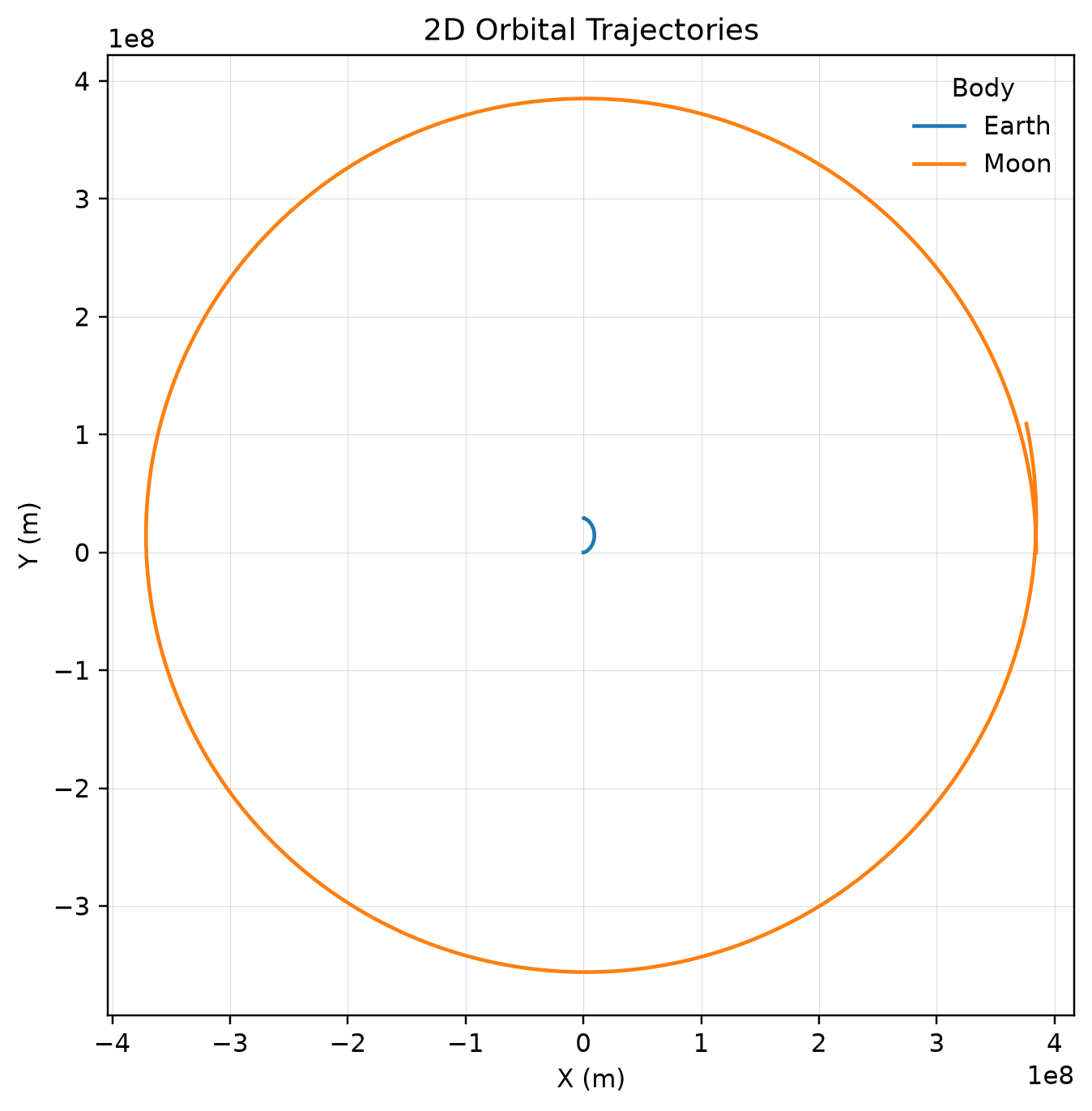
The same constants are behind add_sun(), add_planet(), and load_solar_system(), which use these masses and semi-major axes together with each body’s eccentricity and orientation.
Orbital distances are not truly constant. Every orbit is an ellipse, so the separation between two bodies changes continuously through each revolution. The values provided here are semi-major axes: the average of the closest approach (periapsis) and the farthest point (apoapsis).
The semi-major axis \(a\) is the most characteristic length scale of an elliptical orbit. It sets the orbital period through Kepler’s third law,
\[ T = 2\pi \sqrt{\frac{a^3}{G M}}, \]
where \(M\) is the mass of the central body (strictly, the sum of the two masses). For Earth around the Sun the constants give a period of very nearly one year:
import math

period = 2 * math.pi * math.sqrt(
    orb.distance_earth_sun**3 / (orb.gravitational_constant * orb.mass_sun)
)
period / orb.seconds_per_day365.21050633813775You can see the distance vary in a simulation. add_planet() gives Earth its real eccentricity of 0.0167, so over one year the Earth-Sun separation swings between perihelion and aphelion:
sim = (
    orb.create_system()
    .add_sun()
    .add_planet("Earth", parent="Sun")
    .simulate(time_step=orb.seconds_per_hour, duration=orb.seconds_per_year)
)

earth = orb.shift_reference_frame(sim, "Sun")
earth = earth[earth["id"] == "Earth"]
distance_km = (earth["x"] ** 2 + earth["y"] ** 2 + earth["z"] ** 2) ** 0.5 / 1000

distance_km.agg(["min", "max", "mean"]) / 1e6
min 147.101680
max 152.097431
mean 149.619834
dtype: float64The separation runs from about 147.1 million km at perihelion to about 152.1 million km at aphelion. The semi-major axis of 149.6 million km sits in the middle of that range, and it is the value that gives the correct one-year period.
Paired with the mean orbital speed, the semi-major axis produces a nearly circular trajectory that closely approximates the real orbit. The speed of a circular orbit of radius \(a\) is
\[ v = \sqrt{\frac{G M}{a}}, \]
and the built-in mean speeds are close to that value for each planet:
planets = ["mercury", "venus", "earth", "mars", "jupiter", "saturn", "uranus", "neptune", "pluto"]

pd.DataFrame({
    "mean speed (m/s)": [getattr(orb, f"speed_{p}") for p in planets],
    "circular speed (m/s)": [
        round(math.sqrt(orb.gravitational_constant * orb.mass_sun / getattr(orb, f"distance_{p}_sun")))
        for p in planets
    ],
}, index=pd.Index(planets, name="planet"))| mean speed (m/s) | circular speed (m/s) | |
|---|---|---|
| planet | ||
| mercury | 47360 | 47879 |
| venus | 35020 | 35027 |
| earth | 29780 | 29789 |
| mars | 24070 | 24135 |
| jupiter | 13060 | 13058 |
| saturn | 9680 | 9622 |
| uranus | 6800 | 6800 |
| neptune | 5430 | 5434 |
| pluto | 4740 | 4741 |
The two columns agree to within about one percent (Mercury is the furthest off), and for most planets much more closely. The small differences are why a body started with x=orb.distance_earth_sun, vy=orb.speed_earth traces a slightly elliptical orbit and not a perfect circle.
If you want a clearly elliptical orbit, start the body at periapsis with a faster-than-circular velocity, or at apoapsis with a slower one. Building Two-Body Orbits works through the choices, and Keplerian Orbital Elements shows how to ask for a given eccentricity directly.